


Prior authorization has been the slowest part of the revenue cycle for years. Requests sat in fax queues. Decisions took weeks. Patients waited while staff chased status updates. That is now changing. A federal rule took effect on 1 January 2026 and rewrote the timelines payers must meet. Most guidance written about it speaks to insurers and IT teams. This guide speaks to the practice.
What Is CMS-0057-F?
CMS-0057-F is the Interoperability and Prior Authorization Final Rule. CMS released it in January 2024.
It targets two things at once. Faster authorization decisions, and standardised electronic data exchange.
The rule regulates payers, not providers directly. But every requirement it places on payers changes how your practice works.
What Changed on 1 January 2026?
The operational requirements are now live. These are not recommendations.
| Requirement | What it means |
|---|---|
| 72 hours | Decision deadline for expedited requests |
| 7 calendar days | Decision deadline for standard requests |
| Specific denial reasons | Payers must state why, not just refuse |
| 5-year retention | Authorization history must be kept and shared |
| Public reporting | Payers publish approval and denial metrics |
The previous standard allowed considerably longer for standard decisions. That window has closed.
What Is Still Coming?
The rule rolls out in phases. Two dates still matter.
| Date | Milestone |
|---|---|
| 1 January 2027 | Full FHIR-based API implementation required |
| Later phases | Expanded electronic exchange between payers |
Drug prior authorizations sit outside the current rule. A separate proposal addresses those, but it is not final.
Which Plans Are Affected?
The rule does not cover every payer. Knowing the boundary saves wasted effort.
Covered plans
- Medicare Advantage organisations
- State Medicaid and CHIP fee-for-service programmes
- Medicaid and CHIP managed care entities
- Qualified Health Plans on the federally facilitated exchange
Not covered by this rule
- Traditional commercial employer plans
- Self-funded employer plans
- Drug prior authorizations under the current version
So a single practice will run two workflows. One for regulated plans, one for everything else.
Does the Rule Apply to Providers or Only Payers?
This is the question practices ask most. The honest answer has two parts.
Legally, the obligations sit with payers. No practice will be penalised under this rule.
Practically, it changes everything on your side. Faster payer decisions only help if your submissions are complete and electronic. A rule designed for API exchange rewards practices that stop faxing.
What this means for you
- Manual portal uploads become the slow path
- Incomplete submissions still stall regardless of deadlines
- Denial reasons are now specific enough to act on
- Authorization history is retrievable when you need evidence
What Is Gold Carding?
Gold carding is a separate reform track, driven by states rather than CMS.
It exempts high-performing providers from prior authorization on specific procedures. Qualification usually depends on a consistently high approval rate over a review period.
Several states have enacted gold carding laws, including Texas, Louisiana and West Virginia. Additional states passed prior authorization reform legislation containing various provider exemptions.
Before you build a strategy around it, understand the limits.
- Only specific procedures qualify, and the eligible pool is often small
- Excluded procedures still require authorization for everyone
- Maintaining gold card status carries its own administrative work
- Programmes vary widely between states and payers
Gold carding supplements a strong authorization workflow. It does not replace one.
What Does New York Law Add?
Federal rules are only half the picture for New York practices. State insurance law adds protections that many practices never use.
New York Insurance Law addresses pre-authorised services directly. Where a health plan required and issued a pre-authorization, it must pay the claim, subject to limited exceptions.
One provision deserves particular attention. A plan cannot deny a claim solely because coverage was retroactively terminated, if that termination occurred more than 120 days after the service date.
Why this matters day to day
- Retroactive termination denials are not automatically final
- The authorization itself is evidence in your favour
- Documented approval dates become important records
- Appeals on these denials have a statutory basis
Always confirm the current statute language and your specific plan type before relying on it.
Which Specialties Feel Prior Authorization Most?
Authorization burden is not spread evenly. Some specialties live inside it.
Ongoing treatment plans face repeated renewals rather than one-off approvals. Session limits and continuing necessity documentation drive most authorization denials in mental health billing.
Chronic care creates a different pattern. Recurring treatments, specialised therapies and frequent necessity reviews shape authorization work in nephrology medical billing.
Episodic treatment brings its own trap. Advanced modalities and product-specific coverage rules mean authorizations expire mid-episode in wound care billing services.
The pattern across all three is the same. The first approval is rarely the last one you need.
How Should Your Practice Adjust Its Workflow?
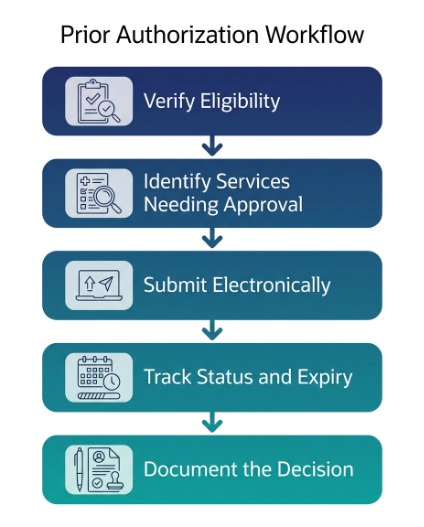
Faster payer deadlines only pay off if your side keeps up. Five changes make the difference.
1. Move off fax and manual portals
Electronic submission is where the new timelines actually apply. Manual channels stay slow.
2. Build a pre-visit authorization check
Flag services that need approval before the patient arrives, not after.
3. Track expiry dates, not just approvals
An expired authorization denies exactly like a missing one.
4. Log the specific denial reason
Payers must now state it clearly. Categorise it and act on the pattern.
5. Verify coverage every single visit
Plans change mid-year. Authorization on a lapsed plan is worthless.
Consistent advanced eligibility and pre-authorization checks remove most of this risk before it reaches billing.
Where Do Software and Credentialing Fit In?
Two supporting pieces decide whether the workflow above holds together.
The first is your system. Electronic submission, status tracking and expiry alerts all depend on it. Practices still working from spreadsheets cannot meet the pace this rule sets.
Modern medical billing software handles submission, tracking and documentation in one place.
The second is provider status. An authorization means nothing if the rendering provider is not active with that payer.
Proactive credentialing services prevent authorizations from failing for reasons that have nothing to do with the request itself.
Turn the New Rules Into an Advantage
The 2026 changes were designed to reduce delay. Whether your practice actually feels that depends entirely on your workflow. Payers now move faster. Practices still submitting manually will not notice the difference.
Our certified team manages authorization submissions, expiry tracking and denial follow-up across New York and all fifty states. You focus on care delivery.
Reach out and contact our billing team to review your current authorization process.
Fast Billing Solutions 68 South Service Road, Suite 100, Melville, NY (631) 500-1007
Faster authorization decisions only help practices that are ready to receive them, and that readiness is built before the request is sent. Fast Billing Solutions helps practices build exactly that.
Frequently Asked Questions
It is the CMS Interoperability and Prior Authorization Final Rule. It sets faster decision deadlines for payers and requires standardised electronic data exchange.
Covered payers must decide expedited requests within 72 hours. Standard requests must be decided within seven calendar days.
No. The obligations sit with payers. But the timelines only work in your favour if your submissions are electronic and complete.
It is a state-level exemption that removes prior authorization for qualifying providers on specific procedures. Eligibility depends on a strong approval history.
Not under the current rule. A separate proposal addresses drug authorizations, but it has not been finalised.
More answers are available on our frequently asked questions page.